 THE RAILWAY AGE began in Britain in 1801, with Richard Trevithick’s steam locomotive, the ‘Puffing Devil’. It carried six passengers along Fore Street in Camborne in his native Cornwall. After three days the engine broke down. Naturally, its operators popped into a pub to discuss the problem. In their absence the water boiled off, the engine overheated, and it blew up. In 1813, William Hedley designed ‘Puffing Billy’ to haul coal, a job the engine did rather well for 50 years. In 1825, the Stockton and Darlington Railway opened, the world’s first passenger and freight railway. Soon a medley of private regional operators emerged and the railway boom began; and with it a social and economic revolution.
It paved the way for the Industrial Revolution. Raw materials and goods could be transported further, faster, unaffected by bad weather (unlike canal and coastal shipping). By 1900 there were 22,000 miles of track across Britain. Commuting began. And workers could take the train to the seaside. The two greatest boons to women’s emancipation were the bicycle and the railway. They offered freedom. Women could travel by train unescorted, safe in Ladies Waiting Rooms, or reserved compartments.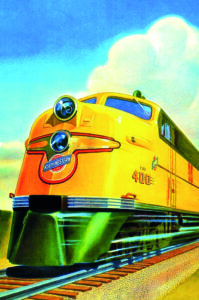
W.H. Smith’s bookstalls were introduced at Euston in 1848. By 1900 they boasted 1200 stalls, with a huge influence on reading and literacy. News and newspapers whizzed across the country. Speed was new. ‘Faster than fairies, faster than witches’ wrote Robert Louis Stevenson (From A Railway Carriage, 1885). As I have never met a fairy or witch socially, I couldn’t comment but an impression of speed was brilliantly caught by Turner in his Rain, Steam, and Speed of 1844. Robert Stephenson’s Rocket (1829) – ‘more than a machine, almost a living being’ (Michel Chevalier) – puffed at a blistering 30 mph on the Liverpool and Manchester Railway, the world’s first inter-city passenger line, the first of thousands across the world. At the opening, William Huskisson MP was just saying hello to the Duke of Wellington when he was hit by the Rocket, unused as he was to steam-propelled projectiles. He was the first fatality of the Railway Age. The first dining car (1879) was on the GNR and cost £50 (in today’s money) for a hot 6-course meal, a step up from the sandwiches of yore which Dickens described as ‘composed of unknown animals within’. Steam travel was not always romantic. The lovers in Brief Encounter (1945) meet because Celia Johnson got grit in her eye from a passing express. The railway created ‘robber barons’ like Vanderbilt in the US. It also spawned the Railway Mania of the 1840s, massive speculation followed by ruinous collapse; but it left infrastructure, a legacy (unlike the dot-com bubble). £3 billion was spent on building railways from 1845 to 1900. By the end of Queen Victoria’s reign over 1 billion passengers were using trains.
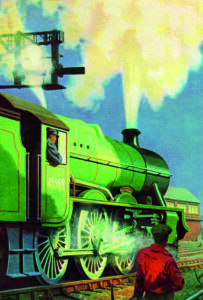
 And what of the LOCOMOTIVES that pulled the passengers and freight? These are my favourites, partly aesthetic: Chapelon’s French masterpiece, the 242A1 (1946), the pinnacle of steam development – beautiful lines, beautiful engineering · Pennsylvania Railroad’s K4 Pacifics (1914), the most successful American passenger locomotive · Gresley’s Flying Scotsman (1923), rightly famous, with a history of record-breaking including the longest non-stop run · Gresley’s Mallard (1938) holder of the world steam speed record of 126 mph · General Motors’ Electro-Motive F-unit (1939) that ‘dieselized’ American railroads and pulled the legendary Super Chief · the streamlined diesel Burlington Zephyr of 1934 (which contrasts favourably with the hideous M-10000) · Milwaukee Road Class A Atlantics (1935) that hauled the Hiawatha · Southern Pacific GS-4 Golden State locos (1941) powering the vibrant Coast Daylight – ‘The Most Beautiful Train in the World’.
Don’t forget Dreyfuss’s Hudson (1938), an Art Deco gem for New York Central that pulled the famous 20th Century Limited, featured in Hitchcock’s North by Northwest (1959), where Cary Grant explained why train travel is best: ‘It’s safer… there’s no place to hide on a plane if anyone should recognize me.’ I find that. And the greatest ad for trains is the airport.
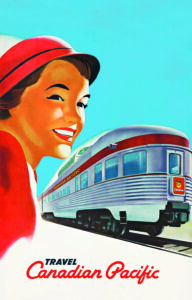
Perhaps that explains some of their enduring appeal. Flying Scotsman and Mallard need little introduction in Britain, while the great American streamliners recall an age when locomotives were not only feats of engineering but objects of considerable style. Railway companies knew it too. Their posters sold speed, seaside holidays and distant cities, often with the locomotive itself as the star: vast, gleaming and thundering towards somewhere you suddenly felt you ought to be going.
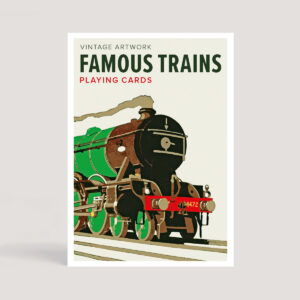
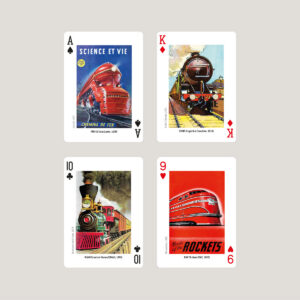
Our Famous Trains Playing Cards bring together some of these great locomotives in historic photographs, posters and railway art, from the early days of steam to the great expresses and streamliners of the 20th century.
Discover the Famous Trains Playing Cards and take a closer look at the locomotives that made railway history.