
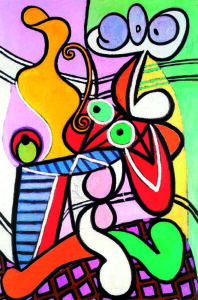
 When I was their age I could draw like Raphael, but it took me a lifetime to learn to draw like them.’ Pablo Picasso, on child art.
PABLO PICASSO (1881-1973) painted Les Demoiselles d’Avignon in 1907. It changed art forever. Five naked sex workers in a Barcelona brothel confront in angular menace, with faces like African masks. It derives from Gauguin, from Cézanne’s brazen nudes, from the directness of Velázquez and Las Meninas (1656). Art evolves, even revolutionary art steals from the past. Picasso’s dealer moaned: ‘It’s the work of a madman.’ It is ugly; but ‘painting is not made to decorate apartments,’ said Picasso, ‘it’s an offensive weapon’. He called it ‘my first exorcizing picture’. Matisse thought Les Demoiselles a bad joke. Georges Braque (1882-1963) was also disturbed yet was seduced by the artist’s genius; and with Picasso took Cézanne’s elements – the cone, cylinder and sphere – and plunged into Cubism (1907-14), reducing objects into geometric forms, using multiple vantage points.
Picasso was born in Málaga, Spain, and was taught to draw by his artist father. He studied at Madrid’s Royal Academy but he preferred to look at Goya, Velázquez and El Greco at the Prado. In 1900, he moved between Barcelona and Paris with a fellow art student whose suicide a year later prompted Picasso’s Blue Period (1901-04), with its gaunt, lonely figures. The Rose Period (1904-06) that followed his depression was an optimistic experiment in primitivism, of mainly carnival themes. In the early 1920s, after the birth of his son Paulo, he began his Neoclassical Period, images of motherhood and mythology. By the early 1930s, he turned to bold colours and sensuous contours. 
The intensity of his affairs (and two marriages) is notorious; they illuminate his art. He veered from reverence to abuse. The last decades were feverishly active, culminating in his late Neo-Expressionism. He lived in the South of France and never stopped experimenting – with printmaking, sculpture, ceramics, painting. Although deeply affected by the Spanish Civil War, and a sometime Communist, he was too committed to creativity to be absorbed in politics. Guernica (1937) remains, however, the most powerful indictment of war. When a German officer saw a postcard of Guernica in Picasso’s Paris flat during the Occupation he asked him – ‘Did you do that?’ ‘No,’ said Picasso. ‘You did.’
Picasso’s importance lies not simply in the violence of his break with tradition, but in the strange continuity that runs beneath it. Even at his most radical, he never truly abandoned the past; he dismantled it, examined it, and rebuilt it in unfamiliar order. The apparent rupture of his work is in fact a long argument with art history itself, conducted in paint rather than words, from the inheritance of Velázquez and Goya through to the fractures of Modernism.
What makes Les Demoiselles d’Avignon (1907) so disquieting is not only its fractured bodies, but its refusal of a single viewpoint. The figures do not inhabit a stable pictorial space, nor do they settle into a coherent relationship with the viewer. Instead, they seem to shift as they are looked at, as though observation itself were being interrupted. The painting does not describe a scene so much as it exposes the act of looking, and in doing so pushes representation towards collapse.
From this point, Cubism (1907–1914), developed alongside Georges Braque, becomes less a style than a method of dismantling certainty. Objects are no longer fixed presences but shifting accumulations of perception, broken apart and reassembled as though vision itself were fragmentary. In Analytic Cubism, form is reduced to muted, interlocking planes; in Synthetic Cubism, fragments of the real world return, but only as reconstructed signs rather than stable objects. In both, the idea of a single, authoritative viewpoint disappears.
This instability is already present in the earlier periods, though in quieter form. The Blue Period (1901–1904), with works such as The Old Guitarist (1903), holds its figures in a state of withdrawal, as if they are cut off not only from society but from time itself. The Rose Period (1904–1906) softens this mood, introducing circus performers and harlequins, yet the lightness feels fragile, as though it has not quite escaped the gravity of what came before.
The Neoclassical Period (1917 onwards), seen in works such as Three Women at the Spring (1921), appears to restore balance through monumental form and classical reference. Yet the bodies feel staged rather than restored, as if order has been reconstructed from memory rather than recovered from tradition. Even here, stability is something performed rather than achieved.
By the time of Guernica (1937), painted in response to the bombing of the Basque town during the Spanish Civil War, Picasso’s fractured language is pushed into historical urgency. The broken space, the distorted bodies, the screaming horse and fractured light form a world where destruction has itself become the structure of the image. It is not simply a painting about war, but a space in which war has already taken place and continues to reverberate.
Across Cubism, Neoclassicism, and the late works often described as Neo-Expressionist, Picasso returns again and again to the instability of form. Nothing is allowed to settle into final definition. Each work feels provisional, as though it is testing what painting can still hold without fixing it in place. It is this refusal of resolution that leaves his work perpetually open — as unsettled now as it was in 1907, still in motion, still resisting completion.
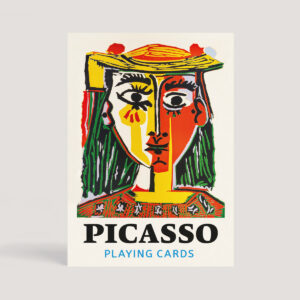
Bring home the bold energy of Picasso with this striking deck from Bird Playing Cards, available to purchase now.

h5qy5b
yjrbrb
oohbj5