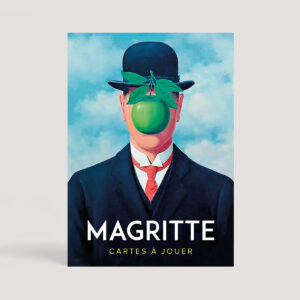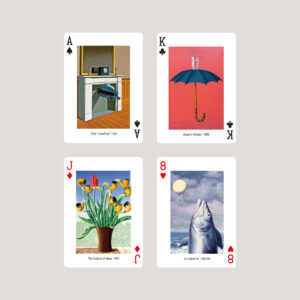
 RENÉ MAGRITTE (1898-1967) was born in Belgium. His father was a tailor. His mother drowned herself when René was 13. She was found with her dress covering her face, which may have inspired Magritte’s paintings of faces obscured by cloth.
He studied art at the Academy in Brussels, which he found dull. His early works were often of female nudes, influenced by Futurism. In 1922 Magritte married his childhood friend Georgette Berger (they never had children). He needed work so he designed advertising designer posters until 1926, when a contract with a local gallery allowed him to paint full-time. He had no romantic illusions. ‘Life obliges me to do something, so I paint.’ He was always a realist, a sceptic. The next year he held his first exhibition in Brussels. The critics laughed. Stung, Magritte moved to Paris where he befriended André Breton, the writer of the first Surrealist Manifesto (1924) – which Breton defined as ‘pure psychic automatism’. For Magritte, Surrealism became something wider – the unexpected connections between things, the limits of vision, the secret life of objects and what they conceal (if anything). Magritte had been transfixed by a reproduction of Giorgio de Chirico’s The Song of Love (1914).
In the 30s, the English patron Edward James supported him. But Magritte despised privilege, despite the money it provided. He flirted with communism. Yet he lived untroubled in Nazi-occupied Brussels during the war (to Breton’s horror). There was something of the gadfly about Magritte. He fell under Renoir’s spell (1943-47). And then, in 1948, he flirted with his so-called Période vache (vache = nasty): crude, Fauvist pictures based on comic book art (for his first Paris exhibition). But abruptly – after pleading from Georgette and his New York dealer – he switched back to his successful, graphic Surrealist style. Although not before he had flirted with crime – forging Picassos, Van Goghs and even banknotes. Throughout his life Magritte made accommodations. With politics, with conscience, with commerce. Before Warhol, Magritte saw the power (and financial sense) of creating series of the same picture, creating multiples. His famous Ceci n’est ce pas une pipe (1929) is pure Magritte – meticulously painted, witty, paradoxical. But do not look for messages. ‘My paintings evoke mystery [but] they do not mean anything, because mystery means nothing either, it is unknowable.’ The painting’s other title sums up Magritte’s manifesto – The Treachery of Images.
René Magritte occupies a unique place in 20th-century art, where image and idea are held in deliberate tension. Unlike many of his Surrealist contemporaries, Magritte did not seek dreamlike chaos or automatic expression. Instead, he constructed precise, almost clinical compositions that quietly destabilise perception. His work asks not for interpretation, but for reconsideration—what do we really see when we look at an object, a word, or a face?
This intellectual clarity is what gives Magritte’s imagery its enduring power. Paintings such as The Treachery of Images and The Son of Man are not simply visual puzzles, but philosophical provocations. They sit at the intersection of language and reality, reminding us that representation is never the same as truth. It is this controlled ambiguity that continues to make his work instantly recognisable and endlessly reinterpreted.
Magritte’s influence extends far beyond painting. His visual language has shaped advertising, graphic design, photography, and contemporary popular culture. The idea that everyday objects can be rearranged into quietly impossible situations has become a visual shorthand for surrealism itself. In this sense, Magritte is not just an artist of the past, but a continuing presence in how we understand modern imagery.
Seen together, his work forms a world where nothing is entirely as it seems, yet everything feels strangely familiar. It is this balance—between the ordinary and the uncanny—that makes Magritte’s art so compelling, and so perfectly suited to collectible interpretation.
Explore the surreal beauty of his most iconic works and purchase the René Magritte surrealist art pack of playing cards now.