
CAPONE and GANGSTERISM
‘Don’t get the idea that I’m one of these goddam radicals. Don’t get the idea that I’m knocking the American system.’ Al Capone, 1930
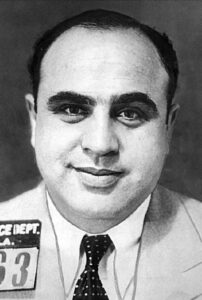 AL CAPONE (1899-1947) saw himself as a businessman. ‘I make money by supplying a public demand… I don’t interfere with big business… I don’t interfere with their racket. They should let my racket be.’ His businesses – illegal booze, illicit gambling, vice, union and protection rackets grossed around $105,000,000 in 1928 alone. Nice work. And Capone was a significant employer – 600 hoodlums were required to keep rival gangs at bay (life expectancy for a gangster, incidently, was 27). In 1928 there were 20,000-odd places in Chicago you could buy a drink. Speakeasies stayed open because cops were bribed to look the other way.
His dominant position was achieved through violence. It was unhealthy for good citizens to talk to the police (themselves often corrupted) and fellow gangsters didn’t squeal. What had given his lucrative trade its impetus was the National Prohibition [Volstead] Act of 1920, banning the sale of alcohol. Criminals with muscle stepped into this government-imposed gap in the market. Turf wars resulted, culminating in the St. Valentine’s Day Massacre of 1929 when Capone whacked 7 of ‘Bugs’ Moran’s mob, leaving Capone master of the Chicago underworld.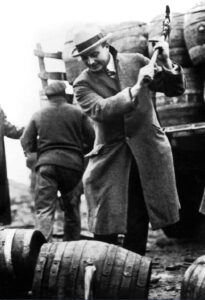
But the public were appalled. The Chicago Crime Commission named him Public Enemy No. 1. Eliot Ness and his nine ‘Untouchables’ (young, incorruptible Justice Dept. agents) raided Al’s breweries and distilleries. But it was the Internal Revenue’s Enforcement Branch that put Scarface Al away. An earlier 1927 Supreme Court decision ruled that income tax must be paid on the proceeds of crime (Capone called it ‘bunk –the government can’t collect legal taxes from illegal money’). The I.R. infiltrated Capone’s gang and found the evidence to convict him of tax evasion in 1931. He went to Alcatraz moaning – ‘some creep gets me on a damn tax rap… ain’t that a helluva deal?’ Released in 1939, now suffering from advanced syphilis, he was met by his old partner in murder Jake ‘Greasy Thumb’ Guzik, who told reporters: ‘Al is nutty as a fruitcake.’ Capone died of a brain haemorrhage on January 19, 1947.
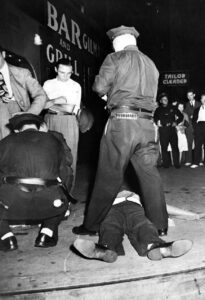 In the next decades the Mob prospered, infiltrating legitimate business, particularly the casino industry. FBI Director J. Edgar Hoover refused to admit the existence of an ‘underworld crime syndicate’ and looked the other way (possibly blackmailed to do so). Mobsters still whacked each other, in vicious power struggles within the Mafia’s 26 Families. Mob bosses like Gingello (Rochester Family), Anastasia (of Murder, Inc.), Galante (Bonanno Family), Frank and brother Joseph Scalise (Bronx Mafiosi), Eboli (Genovese Family), Philip Mangano (Gambino Family), Trafficante (Tampa boss), Giancana (Chicago boss) and Castellano (Gambino Family) – to name a select few – were all rubbed out, mostly in restaurants. Others like Frank Costello were shot, survived and – sensibly – retired. Teamster boss Jimmy Hoffa ‘disappeared’, as did Vince Mangano, Philip’s brother. Sicilians no longer dominated the Mob – Meyer Lansky (‘The Syndicate is bigger than US Steel’) was Jewish for example. Corruption continued. Sam Giancana was overheard in 1957 to say – ‘We got three towns just outside of Chicago with the police chiefs in our pocket. We got this territory locked up.’
Today goodfellas have dispensed with the spats and tommy guns, and come armed with lawyers. Its roots, though, as a US Senate report stated, ‘go back to the operations of the Capone gang… ‘
Capone’s story has come to define the mythology of the American gangster. The tailored suits, the public bravado, the casual violence—all became part of a cultural template that still shapes how organised crime is imagined today. The reality, of course, was less glamorous: a volatile mix of opportunism, brutality, and political corruption that thrived in the peculiar conditions created by Prohibition-era America.
The rise of organised crime in Chicago during the 1920s was not an isolated phenomenon but part of a broader national pattern. Cities across the United States saw similar syndicates emerge, exploiting illegal markets and weak enforcement. What distinguished Capone was scale, visibility, and a certain brazen confidence—he operated not in the shadows, but almost in plain sight, cultivating an image as much as a criminal empire.
Even after his fall, the structures he helped build endured. The shift from street-level violence to corporate-style organisation marked a turning point in the history of the American Mafia. Crime families became more disciplined, more discreet, and far more embedded in legitimate business. The guns were quieter, the profits larger, and the risks—at least for those at the top—considerably reduced.
If you are interested in starting or building a collection, you can find more about Bird Playing Cards on our art playing cards page.
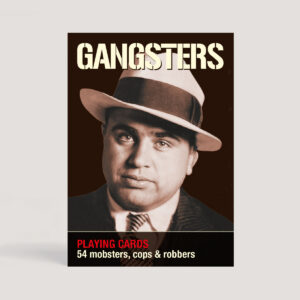
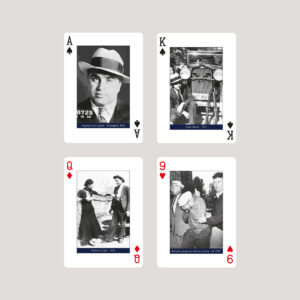
Get the Mob round the table and purchase our Gangster Playing Cards pack today.
Why not start a collection of true crime and history-themed packs with our notorious Infamy and Mugshots and Spies playing cards.
2e1vdn
dvfidy
nji6be
vs8kiu