
WHEN THE ENGLISH AESTHETE William Beckford arrived in Venice in 1780, he noted that ‘Canaletto conveys so perfect an idea’ of the city that any description was ‘superfluous’. Canaletto caught the ‘idea’ of Venice, caught its peeling grandeur, the bustle of canals; he rendered in exquisite detail the precision and frippery of ornament, of gondolas, of arch and architrave. A contemporary painter, Marchesini, wrote that Canaletto’s work ‘astounds everyone… you can see the sun shining in it.’
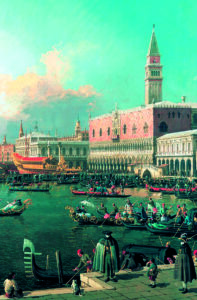 CANALETTO (Giovanni Antonio Canal, 1697-1768) was the son of a stage painter. His art may be a bravura exercise in perspective (and use of the Camera Obscura), but it exchanged the pedantry of mere scene painting for drama and composition. He manipulated what he saw. He first made detailed and accurate sketches, on site, noting where the sun glinted, the colour of shadow. Then he returned to the studio and might take two viewpoints and meld them into one panorama (given depth and movement by striking cloud effects) – perhaps removing a pillar, enlarging an arch, adding a wagging doggy. The key events in his life were meeting the British Consul, Joseph Smith, and the War of the Austrian Succession (1740-48), which effectively closed Venice to English Grand Tourists – the main punters – and prompted Canaletto to take his studio to London. Smith spotted the artist’s talent early, formed an unrivalled collection (cheaply), and became his agent, for a nice percentage. He bought the Palazzo Balbi on the Grand Canal.
Critics like Joshua Reynolds scorned Canaletto’s ‘drudgery’, his ‘imitation’ of what he saw which was ‘merely mechanical’. John Ruskin disdained his later graphic technique (‘a ruled penmanlike line’) with its repetition of effects: wiggly waves, blobs of paint for faces, oil paint used thinly to speed execution – all to meet demand.
But his painting, even the London canvasses and those he created on his return to Venice (1755), often show the perfection of manner, not shortcuts; they reveal how the artist needed only a virtuoso flourish to show a gondola’s wake, or its ferò da próva. My favourite detail is a slice of life from The Stonemason’s Yard (c1725). A baby throws a temper tantrum in the dirt. His sister gawps. Mum pleads. A mason a few feet away continues chiselling. Life goes on.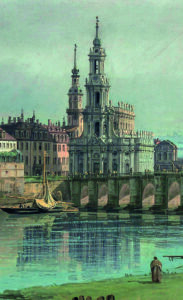
BERNARDO BELLOTTO (c 1721-1780) was born in Venice. He was Canaletto’s nephew and most gifted student. Unlike his uncle, who was not a keen traveller (Rome and England excepted), Bellotto painted vedute in Vienna, Turin and Warsaw – and Dresden (a commission turned down by his uncle). He sometimes signed his name ‘Canaletto’ for marketing reasons. Bellotto’s work is usually more sombre in colour than his master, more Dutch, but his light reflects the native light of the scene depicted (Canaletto’s English painting are Italianate in tone). If the sun is mostly cooler in Bellotto’s painting and gondoliers more static, a masterpiece like his Arno River with the Ponte Vecchio (1742) shows another side. It has Canaletto’s contrasted light and meticulous architectural detail, but it’s freer, with impasto (in the sky) and broader brushstrokes. The frolicking boys in the boats are a genre detail, a joyful frivolity, all his own.
Canaletto, like the English, saw Venice as theatre – with the Grand Canal as stage, the buildings as curtains, architecture as scenery. Academicians sneered: he was a common view-painter for tourists. Well, the trade wanted a souvenir. So he gave them one: sights, sun and fashionable figures with some lowlifes for light relief. It was brilliant. And it was portable. A sort of fridge magnet in Panavision.
The appeal of Canaletto’s Venice also lies in its extraordinary clarity of composition, which helped define the genre of vedute painting in 18th-century Europe. Unlike earlier topographical traditions, Canaletto’s work does not simply record place but organises it into a legible visual system. Streets, waterways, and façades are arranged with such precision that the viewer is guided through the scene almost as if walking it. This structured approach made his paintings especially attractive to Grand Tour travellers, who sought not only mementoes of Venice but an idealised map of their own cultural experience.
Part of this success was due to the rising demand for Grand Tour art in Britain, where Venetian paintings became symbols of education, taste, and social status. Owning a Canaletto was not simply decorative; it signalled participation in a wider European cultural tradition. Venice itself, as seen through his work, became a shorthand for refinement and cosmopolitanism. The city’s architecture—its domes, bridges, and façades—was transformed into a kind of visual language understood across aristocratic Europe.
Canaletto’s technical methods also contributed significantly to the precision of his vision. His use of the camera obscura allowed him to study perspective with remarkable accuracy, yet he never treated it as a mechanical substitute for artistic judgement. Instead, it became a tool for refining observation. He would adjust proportions, intensify light effects, and subtly alter spatial relationships to enhance clarity and theatrical impact. The result is a body of work that feels simultaneously exact and heightened, rooted in observation but shaped by imagination.
This balance between realism and invention is central to the enduring fascination of Canaletto paintings today. They offer a version of Venice that feels both historically grounded and aesthetically perfected. Architectural historians value them for their detail, while art historians recognise their role in shaping the European tradition of urban landscape painting. In both cases, Canaletto occupies a pivotal position between documentation and design, between the city as it was and the city as it could be seen.
His influence extended far beyond Venice, helping to establish a visual grammar for cityscape painting across Europe. Later artists adopted his techniques of structured perspective, atmospheric depth, and controlled human activity to bring order to complex urban environments. In this sense, Canaletto did not merely depict Venice; he helped define how cities themselves could be represented in art.
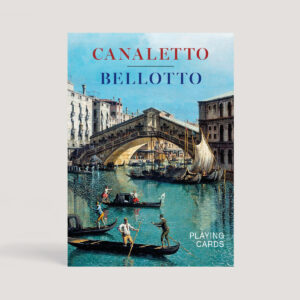
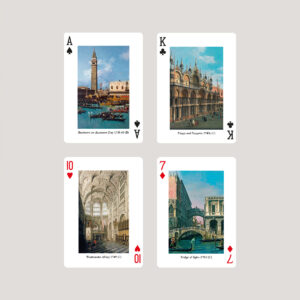
Own the elegance of Venice with this beautifully detailed Canaletto deck from Bird Playing Cards, available to purchase now
51yy3h
kkpvp1
j8xo6n
k9813q
8gy868