
Modigliani said to me time and again that he wanted a short but intense life. Jacques Lipchitz, 1954
 AMEDEO MODIGLIANI (1884-1920) got his wish. He died of tuberculosis, aged 35, in Paris. But his health was shattered by drink and drugs. Yet in that ‘short but intense life’ he created sculptures and figurative paintings of classical beauty. His life was almost a caricature of the bohemian artist in novels and opera: consumptive, subversive, poetic (‘I never met a painter who loved poetry so much’ – Ilya Ehrenburg)…but greedy for booze and opium and tempestuous women. Of Jewish descent, Modigliani was born in Livorno under ‘the auspices of ruin’ (as he put it), his father having just gone bankrupt. His doting French mother kindled the sickly boy’s passion for art by encouraging his travels and studies. Aged 22, he left for Paris and a Montmartre commune.
His friend Picasso is quoted as saying ‘good artists copy, great artists steal’. If so, Modigliani was a great artist. He painted his lover, the art student Jeanne Hébuterne, some 20 times. Where did she get her mask-like face with its long triangular nose? From Picasso’s 1907 Les Demoiselles d’Avignon. Early works like The Cellist (1909) show his debt to Cézanne in their tonal range and creation of volume and depth with flat brush strokes. But while Picasso saw ‘the primitive’ in African art, and agitation, Modigliani saw calm. Brought up in Tuscany, he absorbed Botticelli’s sinuous line, his clarity. To which he married the directness of Goya and Velázquez, and the elegance of Ingres. In 1909, after meeting the sculptor Constantin Brancusi, Modigliani began to carve in stone (inspired also by Gauguin’s directly carved sculptures), completing about 25 works before the dust began to trouble his lungs and he was forced to return to painting. The sculpted heads, elongated and abstracted (yet almost Egyptian in feel), are echoed in his later portrait paintings. From 1914 to his death in 1920 he painted mostly solitary human figures, and nudes. If the pose is Titianesque, there is nothing chaste about the approach. And although not exactly voluptuous (‘I don’t like buttocks’ he told Renoir), it still oozes sex. It is lascivious. The police caused trouble at his only solo exhibition (1917), objecting to the brazen display of pubic hair.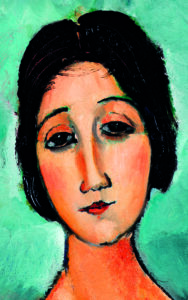
Modigliani said: ‘Every great work of art should be considered like any work of nature…by what moved and agitated its creator.’ He was moved by passion. Yet there is something else in his portraits, with their button mouths and delicacy, like the perfection of Perugino. They are restrained and intimate and tender. ‘When I know your soul I will paint your eyes.’ Jeanne Hébuterne’s eyes always look infinitely sad. Two days after tuberculosis finally claimed Modigliani, she killed herself and her unborn child.
In his Paris years Modigliani also became part of the restless creative ferment of Montparnasse, where poverty and brilliance often occupied the same room. He shared studios, meals and ideas with poets and painters who were equally intent on breaking with academic tradition. This was a world where art and life were deliberately blurred, and where aesthetic experiment was inseparable from personal excess. Within that atmosphere, Modigliani refined his unmistakable visual language: reduced forms, elongated proportions and a haunting sense of stillness that set him apart even among radicals.
Despite the apparent simplicity of his portraits, Modigliani’s work is deeply constructed. He was fascinated by proportion and harmony, often simplifying facial features into near-abstract signs while preserving an extraordinary psychological presence. The tilted heads, almond eyes and elongated necks are not mannerisms but a deliberate search for an idealised human form, at once classical and modern. In this sense, his paintings bridge Renaissance balance and early modern abstraction, offering a vision of humanity that feels both timeless and fragile.
In his final years, illness sharpened rather than diminished his intensity. Working quickly and instinctively, he produced some of his most powerful portraits, marked by an almost spiritual economy of means. There is little background, little distraction—only presence. This stripping away of detail gives the works their enduring emotional force, as though each sitter is suspended in a quiet, unresolved moment. Even now, Modigliani’s figures retain that rare quality: they feel simultaneously distant and intimately known, like memories that refuse to fade.
Add the refined elegance of Modigliani to your collection with this distinctive deck from Bird Playing Cards, available now.


eygl43
OhhUcEIOubNyCDaSvXsZ