
Length: 882.5 feet Gross tonnage: 46,329 tons Service speed: 21 knots Top speed: 24 knots Complement: 2208 (maiden voyage) First-class: 324 Second-class: 285 Third-class: 708 Crew: 891 Survived: 705 (estimate) Died: 1523
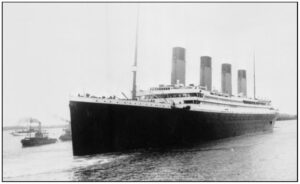
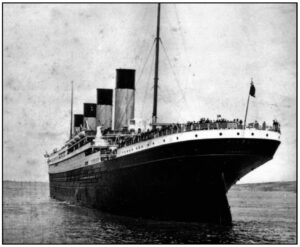
Titanic began her maiden voyage to New York from Southampton on April 10, 1912. At 11:39 p.m. (ship’s time) on the night of 14 April, while travelling at a speed of 22.5 knots, her lookouts saw an iceberg dead ahead less than half a mile away, and alerted the bridge. The First Officer’s instinctive reaction – to reverse engines and turn towards port – proved fatal as the ship’s rudder became ineffective when the irreversible central propeller ceased to turn. Titanic hit the iceberg a glancing blow on her starboard bow, after turning a mere 2 points (about 22 degrees). Rivets popped, plates buckled and five compartments were flooded determining her inevitable fate. At 2:20 a.m. on April 15 Titanic sank (at 41.44 N. 49.57 W. as Dr. Ballard discovered in 1985, not the famous 41.46 N. 50.14 W. she radioed which was 13 nautical miles to the west, and a little north). Inadequate loading of lifeboats added to the death toll. The survivors in the ship’s twenty lifeboats were rescued by Cunard’s Carpathia, the nearer Californian having failed to respond to Titanic’s rocket distress signals, or her frantic SOS calls (Californian’s one radio operator was asleep). The loss of this majestic and ‘practically unsinkable’ ship shocked a world grown complacent – ‘Never glad confident morning again!’ The Titanic and its destruction came to symbolise the end of optimism among nations that were soon to experience the catastrophe of the Great War. John Thayer, a Titanic survivor, wrote of the sinking: ‘The event which not only made the world rub its eyes and awake, but woke it with a start…the world of today awoke April 15, 1912.’ Osbert Sitwell called it ‘a symbol of the approaching fate of Western Civilization’.
There was dignity in death. Mrs. Isidor Straus refused to leave her husband, co-owner of Macy’s in New York – ‘We lived together, so we shall die together’. A witness recalled that as Titanic ‘disappeared beneath the water Mr. and Mrs. Straus were standing arm in arm.’ Benjamin Guggenheim and his manservant changed for death, as Mr. Guggenheim would change for dinner – ‘We’ve dressed up in our best and are prepared to go down like gentlemen.’ In the trenches such Edwardian nobility would seem an age away.
The loss of the RMS Titanic remains one of the most extensively examined maritime disasters in history, a defining moment in early twentieth-century ocean travel. Built by the White Star Line as the pinnacle of Edwardian engineering ambition, Titanic was designed to embody comfort, scale, and supposed invincibility. Yet her sinking in April 1912 exposed critical flaws in maritime safety practices of the era, particularly the overconfidence in watertight compartment design and the inadequate provision of lifeboats for all passengers and crew. Today, the Titanic disaster continues to serve as a central case study in maritime law, ship design, and emergency preparedness at sea.
In the wider context of the North Atlantic shipping routes, Titanic’s collision with an iceberg highlights the constant and often underestimated danger of transatlantic crossings in the early 1900s. Ice warnings had been received by multiple vessels in the region on the night of 14 April 1912, yet communication systems were still primitive, uncoordinated, and frequently ignored or delayed in transmission. The resulting tragedy revealed a catastrophic gap between technological progress and operational safety protocols, reshaping international maritime regulations in the years that followed the disaster.
The role of nearby ships during the Titanic sinking has also been subject to enduring historical scrutiny. The SS Californian, positioned within sight of Titanic’s distress rockets, failed to respond in time due to radio silence and misinterpretation of signals, while the RMS Carpathia, navigating hazardous ice fields at full speed, ultimately rescued the survivors from lifeboats in the early morning hours of 15 April 1912. These contrasting responses have become emblematic of both the limitations and the heroism present in maritime operations of the period.
Beyond the technical and logistical failures, the Titanic disaster has come to symbolise the final collapse of Edwardian certainty and the fragility of early twentieth-century modernity. The loss of over 1,500 lives transformed public perception of technological progress, shattering the belief that human engineering had finally conquered nature. In cultural memory, the tragedy marked a psychological turning point—an event that foreshadowed the wider upheavals of the First World War and the end of an era defined by confidence, hierarchy, and imperial stability.
Today, the RMS Titanic remains a powerful historical and cultural reference point, explored in books, documentaries, and continued deep-sea exploration of the wreck site discovered by Dr Robert Ballard in 1985. The enduring fascination with the ship reflects not only the scale of the tragedy but also its symbolic weight as a cautionary tale about ambition, complacency, and the limits of human control in the face of nature’s power.
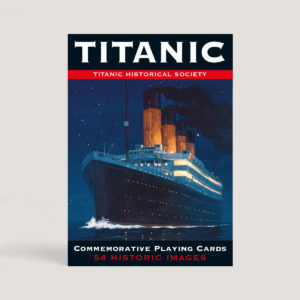
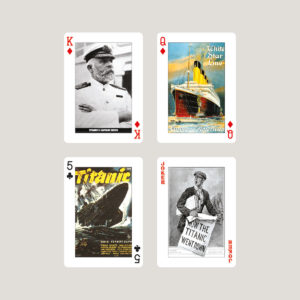
Add a piece of maritime history to your collection with the Titanic deck from Bird Playing Cards, available to order today
ygs0kz