 JOAN MIRÓ (1893-1983) was a contradiction: a bohemian in attitude but who dressed as a businessman at the easel; taciturn and sober, he belied his playful artistic style, his rejection of the commercial. He was ‘utterly free of disorder or excess’ said a friend. Miró was a quiet iconoclast, contemptuous of much conventional painting. By upsetting the visual elements in art he declared an ‘assassination of painting’. He loathed any surrender to the diktats of dealers. He was distressed by a visit to Picasso’s studio in Paris in 1920. ‘Picasso is a great painter (but) everything is done for his dealer…In other places I saw paintings by Marquet and Matisse; there are some that are lovely, but they do a lot just for the money. In the galleries you see some senseless junk…’
Miró was born in Barcelona. His parents wanted their boy to be a businessman. He tried but had a nervous breakdown (he suffered from depression all his life). ‘What I will not accept is the mediocre life of a modest little gentleman.’ So he studied art in Barcelona and co-founded a short-lived movement, Agrupación Courbet, which promoted both the realism of Courbet and Catalan art. He then went to Paris which was the artistic hub of the twenties. Picasso, who opened doors for him, supposedly said ‘good artists copy, great artists steal’. Miró ‘stole’, or absorbed, Cubism and Picasso and Braque, Van Gogh and Cézanne, the Fauves. But it worked both ways. On a visit to Picasso’s studio, Miró saw a sculpture that was just like one of his. ‘Pablo,’ he said, ‘this sculpture is mine.’ Picasso smiled: ‘No, Joan. This sculpture is ours.’
Miró’s vision was shaped above all by Surrealism. The poet André Breton felt that Miró ‘was the most surrealist of all’. His process wasn’t unconscious, but – initially – wasn’t planned either. ‘When I stand before a canvas, I never know what I’ll do; as I paint the picture begins to assert itself, the form becomes a woman or a bird as I work… The first stage is free, the second is carefully calculated.’ Miró’s approach was organic. ‘I work like a gardener.’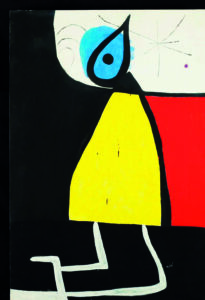
If he admired contemporaries like Klee and Calder, he also looked back to the restricted palette and bareness of early frescoes, and their ‘eloquence of silence’. ‘I’m overwhelmed when I see, in an immense sky, the crescent of the moon, or the sun. As in my pictures, tiny forms in huge empty spaces.’ His art is visual poetry. ‘Painting should give off sparks. It must dazzle like the beauty of a poem… I make no distinction between poetry and painting.’
In the 1930s, he explored collage, engraving, ceramics and sculpture. Always with wit and colour and with lust for the childlike. The Spanish Civil War saw him take sides, and create posters and murals for the republicans. He loathed Franco, but was never as visceral as Picasso. With the coming of the German occupation of France, where he lived, he decamped to Palma de Mallorca. After the war he was lionised by a new generation. His bold colour, gestural marks and automatism (unconscious creativity) influenced Jackson Pollock and the Abstract Expressionists, who recognised what Miró achieved – in Miró’s words ‘the maximum of intensity with the minimum of means’.
Miró’s mature work after the Second World War pushed even further into reduction and symbolic clarity. His canvases became fields of near-monochrome space punctuated by signs, stars, birds, eyes and biomorphic shapes that seem at once primitive and futuristic. This pared-down visual language was not simplicity for its own sake, but a deliberate stripping away of excess in search of emotional immediacy. In works such as his Constellations series, he created vast cosmic maps where floating forms suggest navigation through dreamscapes rather than physical reality. The result is a uniquely recognisable contribution to modern art that helped define the direction of post-war abstraction.
Throughout his career, Joan Miró maintained a deep connection to Catalonia, even when living in exile. The landscape, folklore and rhythms of Catalan identity quietly permeate his work, not as literal depiction but as encoded symbols and recurring motifs. This sense of rootedness gave his seemingly playful compositions a deeper resonance, grounding his radical experimentation in cultural memory. Even when his forms appear childlike or spontaneous, they are underpinned by a disciplined visual grammar that he refined over decades of relentless experimentation.
By the 1950s and 1960s, Miró’s international reputation had grown to enormous stature, and his influence could be seen across the emerging currents of modern art. Artists associated with Abstract Expressionism, particularly in the United States, responded strongly to his use of gesture, automatism and emotional scale. His ability to balance control and accident, structure and freedom, offered a crucial bridge between European Surrealism and American abstraction. In this sense, Miró became not only a Surrealist master but also a foundational figure in the wider story of 20th-century modernism.
His late work also expanded into monumental public sculpture and large-scale murals, where his imagery gained new physical presence in urban space. These works amplified his lifelong aim to bring art beyond the confines of elite galleries and into everyday experience. Whether in ceramic walls, bronze forms or vast painted surfaces, Miró’s visual language remained instantly recognisable: playful yet rigorous, spontaneous yet deeply composed. He continued working almost until his death in 1983, leaving behind a body of work that feels both timeless and perpetually modern.
Bring home the expressive world of Joan Miró with this vibrant deck from Bird Playing Cards, available to purchase now.


ydfs9k
s2788g
vv7oir
lube9c
w8xhtk