
‘Thank God, I have done my duty.’
Vice-Admiral Horatio Nelson at the Battle of Trafalgar
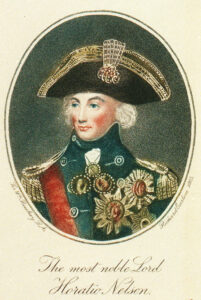 VICE-ADMIRAL Horatio, Viscount Nelson (1758-1805), remains Britain’s supreme naval hero. His boyhood in North Norfolk, where his father was a churchman, brought him close to those who lived hard lives at sea, the basis of his profound empathy with the lot of those who fought below decks. He was deeply influenced by his strong-minded mother, who bore 8 children (he was the third of five boys) and died when he was 9. In 1770 he joined the navy through the patronage of a naval uncle. He attained admiralship in 1797, having married (unwisely) Frances Nisbet ten years earlier. He left this blameless woman in 1801 after a scandalous affair with the beautiful and accomplished Emma Hamilton, the wife of the British ambassador in Naples.
Nelson was adored and trusted by his sailors but his superiors were not always so admiring. His volatility, possibly aggravated by a head wound, his insubordination (notably at Copenhagan in 1801), his cavalier attack on Tenerife (1797) where he lost an arm, his clumsy, callous meddling in Neapolitan politics (1799/1800) – and his vanity and greed for the baubles and honours bestowed upon him by George III – made him a flawed hero in some official eyes. But to the public he epitomised courageous resistance to Bonaparte, particularly after the decisive Battle of the Nile (1798), which marooned Napoleon’s army in Egypt, creating the conditions for a formidable new coalition against France.
Proof of his timely genius, however, came in his final battle (Oct. 21, 1805) fought off Cape Trafalgar, near Cadiz, in which his 27 ships faced the 33 of the French Admiral Villeneuve’s Franco-Spanish force. Napoleon had assembled an army to invade Britain (L’Armée de L’Angleterre) at Boulogne but needed a naval victory to give at least a few days maritime supremacy in the Straits of Dover to transport it safely across. Villeneuve’s ships had been blockaded for long years and the enforced idleness had sapped efficiency and morale (if not bravery). His men and ships were no match for the British fleet, or Nelson; yet Napoleon insisted that Villeneuve fight – even when it became strategically nonsensical after Napoleon sent the Boulogne army to confront Russia and Austria, who had massed against him in a new coalition.
Spurning the convention of engaging in parallel lines, Nelson attacked in two divisions a mile apart at right angles to the enemy, cutting off their rearguard and van (the latter failed to return to the battle). Nelson’s ships engaged ‘pell mell’ at the closest of quarters – the Franco-Spanish centre and rear were overwhelmed, not least by superior gunnery and ship handling. They lost some 2000 killed and many more in the week-long gales that followed. Only 11 of their ships survived, 9 of which escaped before the fighting to Cadiz.
The British lost about 500 men. And in the hour of victory they lost Nelson, who, amidst the crash of big guns all around him, was killed by a single musket shot. He had done his duty. Britain would henceforth dominate the Channel. The nation was safe.
The significance of the Battle of Trafalgar cannot be overstated in the wider context of the Napoleonic Wars. It marked a decisive turning point in European history, ensuring that Napoleon’s ambition to invade Britain was permanently thwarted. From that moment onward, British naval supremacy was unchallenged for more than a century, shaping global trade routes, colonial expansion, and the balance of imperial power across the world.
At the heart of this victory stood Horatio Nelson, whose tactical brilliance and unconventional leadership style redefined naval warfare. His willingness to break from rigid formations and engage the enemy at close quarters reflected not only personal courage but also a deep understanding of the strengths and morale of the Royal Navy. Nelson’s leadership inspired extraordinary loyalty among his crews, who famously followed him into battle with near-unshakeable devotion.
Nelson’s flagship, HMS Victory, remains one of the most enduring symbols of British maritime heritage. It was from her deck that Nelson issued his final orders during the battle, embodying both the drama and sacrifice of the age of sail. Today, she stands preserved as a living museum of naval history, offering a tangible connection to one of Britain’s most defining military moments.
The legacy of Trafalgar extends far beyond the battlefield itself. It cemented Nelson’s status as Britain’s greatest naval hero and ensured his enduring presence in national memory, most notably in London’s Trafalgar Square. His final words, “Thank God, I have done my duty,” continue to resonate as an expression of duty, sacrifice, and leadership under pressure—qualities that have come to define his place in history.
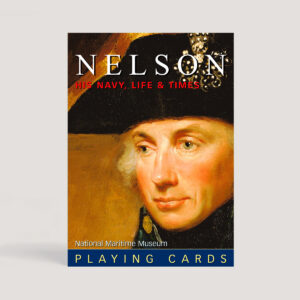
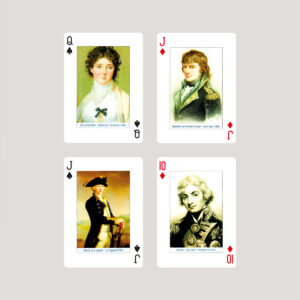
Discover the beautifully illustrated Nelson playing cards from Bird Playing Cards and add a striking piece of naval history to your collection.
5kdusr