
 One object sums up The Bauhaus (1919-1933). Marianne Brandt’s silver tea infuser (c1924). It is stripped of ornament (‘less is more’); beauty derives from form and materials. It’s not a mere gewgaw, it works. The spout doesn’t drip. ‘Bauhaus was a revolution in the relationship between arts and crafts, aesthetics and functions’ – Norman Foster (2019). Its roots are in Ruskin, William Morris, Vienna’s Wiener Werkstätte – and the Dutch De Stijl movement (1917-31).
De Stijl (The Style) was born in Leiden as a response to the chaos of WWI. More an ideal than a movement. Their Manifesto (1918) championed the universal over the individual and sought to ‘abolish the natural form which prevents the clear expression of art.’ Thus abstraction, geometry, straight lines were key. Simplicity was spiritual. Bart van der Leck was the first to distil elements into fundamental forms and reintegrate them in colour – in primary colours – a practice later adopted by Piet Mondrian.
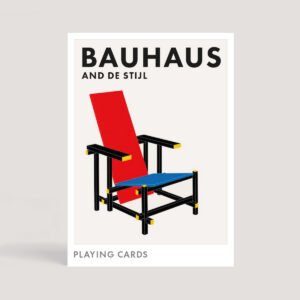
De Stijl’s ambition was ‘the organic combination of architecture, sculpture and painting in a lucid, elemental, unsentimental construction.’ Among its luminaries were Theo van Doesburg and Gerrit Rietveld. Rietveld’s Schröder House (Utrecht, 1924) exudes De Stijl: fluid transitions between inside and outside, clean horizontal and vertical lines, primary colours. The lack of walls, of ‘containment’, mirrored a commitment to openness in relationships. The house is like stepping into a Mondrian (‘The more basic the colour, the purer’). Gemütlich it isn’t. But then Rietveld believed that physical comfort was subservient to the comfort of the spirit – and designed his famous Red Blue Chair (1918) accordingly. Given the rigidity of their art, the artists soon bitched at perceived heresy: van Doesburg described Mondrian’s use of grey as ‘a pollution’. Mondrian was appalled when van Doesburg painted a diagonal.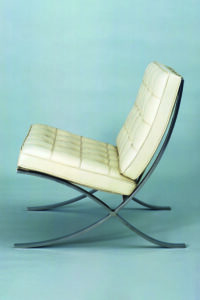
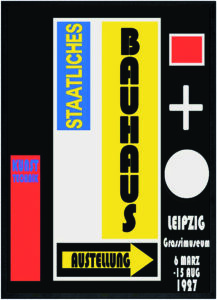
The Bauhaus (an inversion of the German word hausbau – ‘building houses’) was founded by the German architect Walter Gropius in Weimar (it later moved – through withdrawal of civic subsidies – to Dessau and Berlin). He put his mission succinctly – ‘We must return to the crafts!’ His vision, echoing De Stijl, was of a ‘future embracing architecture and sculpture and painting in one unity.’ Moholy-Nagy stressed humanity – ‘Not the product, but man, is the end in view.’ The greatest influence on design for 100 years, the Bauhaus emphasised art for all. ‘Ikea is the realisation of the Bauhaus dream: simple design available at modest prices’ (Craig-Martin, 2019). In 1923, the school adopted the slogan ‘Art into Industry.’ It eroded distinctions between class and hierarchies; between artist and worker, teacher and student (Gropius insisted on ‘friendly intercourse between master and student outside work’). It embraced new technology: in architecture, steel-frame construction and the glass curtain wall; in textiles, under Gunta Stölzl, cellophane and fibreglass; in furniture, under Marcel Breuer, tubular steel. Breuer’s Wassily chair (1925) and cantilevered Cesca chair (1928) are both revolutionary and beautiful, like ‘sitting on air’. Mies van der Rohe (the last director) and Lilly Reich’s Barcelona Chair (1929) married craft and design – its cushions were sewn from 148 pieces of leather (‘God is in the details’).
Form followed function but colour was key; and Gropius’s building in Dessau was vibrant with primary colours. Its workshop made the lamps that lit its passages. Bauhaus textiles softened severe interiors. While the school was idealistic, old traditions persisted. Weaving was for women.
If Josef Hartwig’s chess set and the Wagenfeld lamp (both 1924) remain icons of style and design, perhaps the school’s typography is its most familiar legacy. In 1925 Herbert Bayer (1900-85), head of printing, created a simple geometric sans-serif font that reduced letters to essentials – the Universal Alphabet, father of countless (less successful) modern faces.
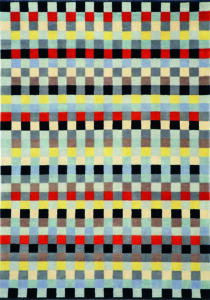 The Bauhaus was a laboratory for artistic experiment. ‘The mind is like an umbrella. It functions best when open,’ said Gropius. He tempered utopian vision with realism; ‘an understanding with industry’ would save the Bauhaus from being ‘an island of recluses’. In its mere 14 years it became a creative factory. Among its teachers were Kandinsky, Klee, Feininger, Le Corbusier, Anni Albers (whose textiles were both craft and art) and Josef Albers (who taught the primacy, and magic, of colour).
By 1933, the school was almost a global modernist cult. To the Nazis it was ‘un-German’, ‘Bolshevist’. Hitler preferred Speer’s Teutonic sentimentality. Nazi pressure forced manufacturers to cancel licences for Bauhaus designs. Then the Arts Ministry insisted that Jews on the staff, and the ‘degenerate’ Kandinsky, were sacked. Mies, apolitical but beset by Marxist unrest within and bile without, simply closed the school.
The influence of Bauhaus design is almost impossible to escape. Its principles of simplicity, functionality and accessible design helped shape modern furniture, architecture, typography, textiles and household objects. The Bauhaus existed for only 14 years, but its ideas have lasted for a century and counting.
Today, Bauhaus furniture and architecture remain instantly recognisable: geometric forms, economical materials, primary colours and the conviction that good design should be useful as well as beautiful. From the Wassily chair to the Bauhaus building in Dessau, its legacy is everywhere. It is difficult to imagine modern design without it.
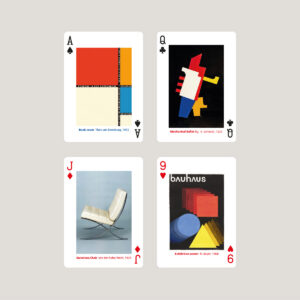
Celebrate the revolution that changed modern design with our Bauhaus playing cards. Each pack brings the geometry, colour and ingenuity of the Bauhaus to the card table, making it a handsome addition to a collection of art and design playing cards and a particularly good gift for anyone fascinated by modernism.
And if Bauhaus has whet your appetite for more major art movements, why not start a collection with our Impressionist Masters, Women Masters and Grand Masters playing cards for more extraordinary artists, movements and masterpieces, each pack turning a game of cards into a miniature art collection.
Buy the Bauhaus playing cards and put a little modernism in your pocket.
unlocker.ai – The Ultimate AI Tool for Bypassing Restrictions and Unlocking Content Seamlessly!
ohbis2
Here you are
Great post,Thanks for sharing
Hi~(* ̄▽ ̄*)
Honestly, it’s really good
uZ8rlF0ykP7dzW5kxD3zdJ6ng_soobshenie
So,I like it
I like this
uZ8rlF0ykP7dzW5kxD3zdJ6ng_soobshenie
uZ8rlF0ykP7dzW5kxD3zdJ6ng_soobshenie
An Engaging Blog Post