HENRI MATISSE (1869-1954)
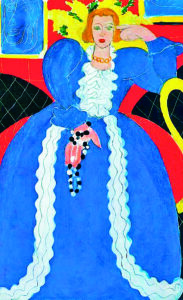 ‘In Matisse we see the decorative, in Picasso the destructive.’ It’s a traditional view, but a distortion. They were both figurative, both abstract. Both celebrated colour and line. They changed our sense of beauty; and they changed art forever. Matisse began the revolution, around 1904, with the ‘brutal’ colour of his ‘Fauve’ period (‘wild beast’). ‘Colours became sticks of dynamite,’ said André Derain, his fellow Fauve; but Matisse was less bombastic. He was finding out ‘how to make my colours sing’, as in his Bonheur de vivre (‘The Joy of life’, 1905-6), an idyllic scene of lovers and dancers, and a landmark in art history. The colours are flat; some figures are drawn sensuously like Ingres, others brazenly like Cézanne. It was greeted with ‘an uproar of jeers, angry babble and screaming laughter’. Yet disconnected elements fused into harmony. Picasso was confused, but inspired. He painted the pioneering Cubist Les Demoiselles d’Avignon (1907). Matisse responded with Madame Matisse (1913), with its calm, a dramatic contrast to the agitation of Cubism. Matisse looks at Cézanne and sees the clarity of figures and shapes, and his childlike drawing style. ‘If Cézanne is right, I am right.’
Born in northern France, he trained as a lawyer but moved to Paris to study art. He fell under the spell of Manet and Cézanne. In 1904, while visiting Paul Signac at Saint-Tropez, Matisse discovered the light of southern France. His palette brightened; he used colour as structure. In 1917 he moved to Nice, and stayed. After his Fauve period, the years 1908–13 focused on art and decoration, followed by four years of experiment (and playing with Cubism); the years 1917–30 were his early Nice period, when his principal subject was the oriental woman, the odalisque (derived from Delacroix), ideally suited to his passion for pattern and hot colours (‘He’s got the sun in his gut’ – Picasso). Then his love of dance and movement led to the exuberance of enormous murals; and finally the cutouts, a culmination of his long struggle to simplify,
to produce an art of ‘balance, purity, and serenity’.
Matisse was fixated with form, with fluency. A critic once wrote: ‘Lemons are not flat, Monsieur Matisse.’ He missed the point. Matisse plays with perception, with abstraction. Shape is suggested, like Cézanne suggests the volume of an orange with flat strokes. ‘When Matisse died,’ said Picasso, ‘he left me his odalisques as a legacy. All things considered, there is only Matisse.’

What Henri Matisse achieved with colour was nothing short of liberation. In works like Bonheur de vivre, colour is no longer descriptive but declarative—an emotional force. This was the essence of Fauvism: colour untethered from nature, used instead to construct feeling, rhythm, and space.
His long dialogue with Pablo Picasso remains one of the great creative rivalries in art history. Where Picasso fractured form, Matisse refined it—paring back complexity in pursuit of clarity. Yet both artists circled the same questions: how to represent reality, and how to transcend it.
In his later years, restricted by illness, Matisse turned to his celebrated cut-outs—paper, scissors, and pure instinct. These works, deceptively simple, distil a lifetime’s exploration of line and colour into compositions of striking immediacy. They are not a retreat, but a culmination: an art of essence, reduced to its most eloquent form.
From the explosive beginnings of Fauvism to the serene clarity of his late cut-outs, Henri Matisse pursued a singular aim: to distil experience into pure visual pleasure. His influence endures not only in the shadow of Pablo Picasso, but across modern and contemporary art, where colour, line, and form remain tools of both expression and liberation.
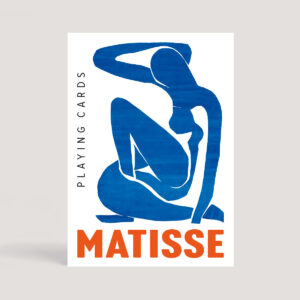
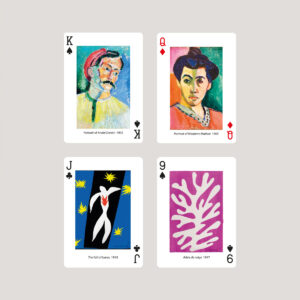
Add the bold colour and flowing line of Henri Matisse to your collection with our distinctive pack of playing cards today.