‘People of Western Europe. A landing was made this morning on the coast of France…’
Gen. Dwight D. Eisenhower Allied Supreme Commander OVERLORD, evening of June 6, 1944
 AN OPPOSED LANDING is one of the most hazardous military operations. Ike’s laconic words hid the complexities, agonising decisions, years of planning and deception that lay behind the invasion, the ‘longest day’ as Rommel called it.
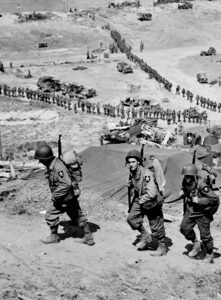
On D-Day 150,000 men were carried by some 7000 ships to liberate France and Europe from Nazi tyranny, and open a Second Front. 30,000 parachutists jumped in the early hours of June 6 to seize crucial bridges and exits, and cut off the Cotentin Peninsular. The French Resistance, prompted by coded wireless messages from London, sabotaged rail and telephone links. D-Day was a near run thing, and but for a break in stormy weather – and Ike’s decisiveness – might have been postponed for 2 weeks, compromising security and morale. Meticulous preparation by the Land Commander, General Sir Bernard Montgomery, and particularly by Admiral Sir Bertram Ramsay in charge of the sea operation (‘Neptune’) prevailed, but stiff German resistance on the cliffs above the American OMAHA BEACH nearly led to disaster. There were 3000 Allied casualties on June 6, 1000 at OMAHA.
The heavy German guns that were supposed to destroy the invader were obliterated by naval fire. Allied deception (‘Fortitude’) and German command confusion fatally delayed German armour, which failed to punch a decisive hole in the Allied line. Gradually the Allies, mainly American, British, Canadian, Free French and Polish on the ground, won the war of attrition. The Battle of Normandy cost Germany 450,000 men, killed, wounded and captured.
The Allied invasion of Normandy, known as D-Day and codenamed Operation Overlord, remains one of the most extraordinary and decisive military operations ever undertaken. Under the command of Dwight D. Eisenhower, the vast undertaking combined land, sea, and air forces in a single, meticulously coordinated strike against entrenched opposition.
From the early hours of 6 June 1944, over 150,000 troops and thousands of vessels crossed the Channel, supported by airborne divisions and an intricate deception campaign designed to mislead German command. The operation demanded precision on an unimaginable scale, where timing, weather, and intelligence all determined success or failure. Even the smallest delays could have altered the course of history.
Despite fierce resistance, most brutally at the American landing zone at Omaha, the Allies established a foothold that would become the turning point in the liberation of Western Europe. The leadership of commanders such as Bernard Montgomery helped sustain momentum across the broader Normandy campaign, ultimately breaking German defensive lines and accelerating the end of the war in Europe.
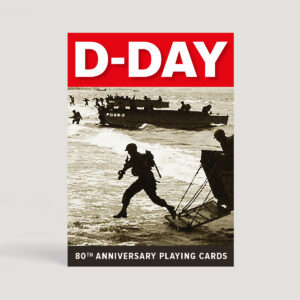
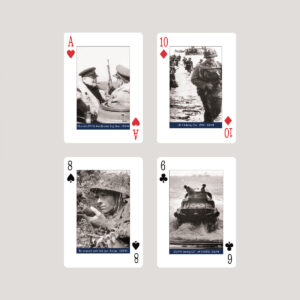
This beautifully designed pack of playing cards transforms that historic moment into a tactile, collectible experience, where every shuffle echoes courage, strategy, and the turning tides of history.
Bring the drama, strategy, and sacrifice of the Normandy landings to your collection. Purchase our D-Day Playing Cards today and hold a pivotal moment in history in every hand.