HENRI ROUSSEAU (1844-1910) was born in Laval, Mayenne, into the family of a tinsmith (who went broke and had his house seized). After high school, where Henri excelled at drawing, he studied law but was caught cheating his employer, a solicitor, out of some petty cash and stamps and sent to jail for a month (1864). When released he joined the army. In 1871 he got a job as a customs official in Paris. Thus his nickname of ‘Le Douanier’.
Rousseau, like his paintings, is an enigma. Was he just a really bad painter? Or was his naivety a pose? A ruse suggested by the painter Jean-Léon Gérôme. The art dealer Ambrose Vollard called Rousseau ‘a sly old dog’. Henri claimed to have seen wild animals while a soldier in Mexico. In fact, he never left France. The zoo was the nearest he got to some sweaty jungle. His paintings are concoctions. His jungles of plants and trees don’t belong in the same hemisphere. What is a white horse doing there? What’s a monkey doing with a milk bottle? The pictures are made up of tigers from Delacroix, a lion from Le Petit Journal… Suburban Paris is mystical, telegraph wires are jungle creepers, people wait, fishers fish, gunners stand around their cannon, with the same faces, the same moustaches. Nothing happens. Does it mean anything? Is Rousseau’s wonky signature part of the pretence of being ‘primitive’?
 Picasso invited Rousseau to dinner in 1907. ‘You and I,’ said Henri, ‘are the two most important artists of the age.’ Picasso and his chums sniggered. They laughed at him but they loved his art – for its gentle innocence (however contrived). And for its affinity with the ‘primitive’. For modern art was born at the zenith of European colonial power: it is the reason African and Pacific masks suddenly came on the market, the reason Gauguin went to Tahiti. It pervaded French popular culture. The rawness and simplicity of primitive art was essential to Rousseau as it was to Picasso’s pivotal Demoiselles d’Avignon (1907).
If he cannot be accused of being a great painter, Rousseau does create something memorable: dreams, poetry, a sense of wonder. He appeals to the child in us. It is the secret of the enduring appeal of his mysterious paintings. But the biggest mystery is – Rousseau.
There is nothing quite like a painting by Henri Rousseau. His jungles are not observed but invented—lush, theatrical spaces where scale is skewed and logic quietly dissolves. It is precisely this unreality that gives his work its peculiar power, placing him outside convention and closer to the language of dreams.
Though often labelled “naïve,” Rousseau’s influence on modern art is undeniable. Artists such as Pablo Picasso and Paul Gauguin recognised in his work something essential: a rejection of academic polish in favour of instinct, imagination and myth. His art sits at the crossroads of innocence and invention.
Today, Rousseau’s paintings continue to captivate for their quiet strangeness. They invite us to look without overthinking, to accept the improbable, and to rediscover a childlike sense of wonder—where meaning is less important than mood, and mystery is the point.
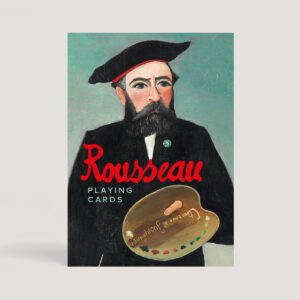
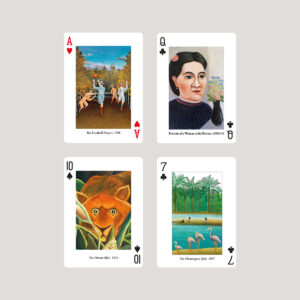
Bring home the dreamlike wonder of Henri Rousseau with our beautifully illustrated pack of playing cards.