
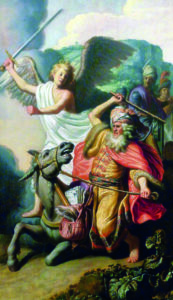
 REMBRANDT’s life could be a Hollywood drama. But unlike Van Gogh, who was ignored, Rembrandt was lionised. His studio was for years a beacon for pompous burghers, the rich, the elite. Apprentices paid him handsomely for the privilege of his teaching. Rembrandt’s etchings sold in thousands. He exploited, even manipulated, their market. If he was revered for his paintings, for their mastery of light and expression (and for the power of his drawings) the etchings – shorn of the tactile appeal of oil and the ‘vanities’ of colour – reveal the artist’s language of ideas, his intellect, compositional finesse. ‘The whole of Rembrandt is in his etchings’ (Eugène Fromentin).
But then things went wrong. Why? He was feckless with money. He went bankrupt in 1656, having bought too grand a house (1639) with borrowed money, and having speculated disastrously. Plagues devastated his family. Only one of his four children by his beloved first wife Saskia (the niece of his patron and landlord) survived infancy, his son Titus (who himself later died of plague). Saskia died in 1642 (the year the Night Watch was painted) and Rembrandt soon started playing footsie-footsie with Titus’s nurse, Geertje Dircks. But that ended badly. Geertje sued him for breach of promise. Rembrandt’s new young lover, his servant Hendrickje Stoffels, testified against her. Geertje lost; Rembrandt had her imprisoned. Hendrickje was later accused of being ‘a whore’ by the local Church Council for cohabiting with the painter (and having his child). He had offended society’s norms by welshing on his debts, and by his impropriety. Patrons deserted him. 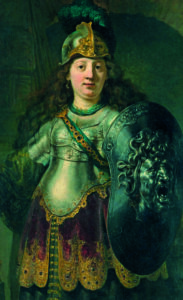
By 1658, Rembrandt’s estate, including his magnificent art collection (assembled even after debts mounted) had been auctioned; he moved to a small house, and lived off a company formed by Hendrickje and Titus to protect him from creditors. All rather humbling. It was the Golden Age of Dutch painting, but – suddenly – not for Rembrandt. He was the victim of his extravagance and a change of taste, ironically pioneered by one of his students, Gerrit Dou. Dou painted highly polished genre scenes, undemanding conversation pieces, to be drooled over for the simple pleasure of gawping at his surface skill. Very far from the psychological expressionism of Rembrandt’s late work. Rembrandt refused to compromise his artistic standards (‘I can’t paint the way they want me to paint’) and paid the price. One price was selling Saskia’s grave in the Oude Kerk. In 1663 plague killed Hendrickje. When Rembrandt died a few years later, perhaps defeated by his own failures, his grave was rented.
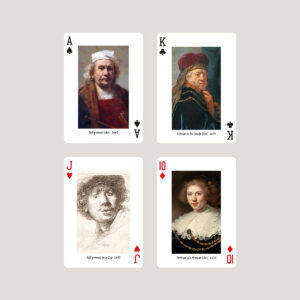
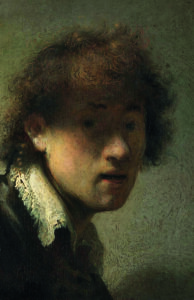 Rembrandt Harmenszoon van Rijn (1606-1669) was born in Leiden, the ninth child of a miller. After flirting with academic life at the University of Leiden, he left to study painting but, unusually for such an avid learner, never travelled to Italy to learn from Renaissance masters; he knew them only from prints. By 1632 he had established a successful studio in Amsterdam, and was lauded for his history and biblical paintings, for his ability to convey feeling through gesture, through dramatic contrasts of light and dark (influenced by Caravaggio). His early style is precise, meticulous. His later paintings use broad brushstrokes, sometimes impasto applied with a palette knife. He described faces with patterns of light and shadow, rather than a single light source. Nowhere is his genius more evident than in his self-portraits, studies in introspection. ‘Life etches itself onto our faces as we grow older, showing our violence, excesses or kindnesses.’ There are about 100. As Kenneth Clark says – ‘with the possible exception of Van Gogh, Rembrandt is the only artist who made the self-portrait a major means of artistic self-expression, and he is absolutely the one who has turned self-portraiture into an autobiography.’ It is the autobiography of a genius, but a genius with all the flaws of nature.
All the best
Enjoy every single day
fhc11a